Every route has a name. Most names are functional — they tell you where you start, where you end, how far you go. The Graspo del Moro is different. Its name reaches back into the agricultural history of Castelnuovo del Garda, into the vineyards and the traditions of a territory that has been growing wine for centuries.
Understanding the name makes riding the route feel like something more than cycling. It makes it feel like reading.
The wine
The Graspo del Moro takes its name from the Moro dal Castel, a historic wine denomination that belongs to the Municipality of Castelnuovo del Garda. For years it was produced exclusively by the Cantina di Castelnuovo del Garda from Veneto IGT Cabernet Sauvignon grapes — a wine of strict traditions and deep local identity.
This is not a mass-market wine. It is a wine that takes years to make, that carries the specific conditions of a specific place in every sip, and that exists because a community decided to protect and celebrate something worth protecting.
The name
The word “graspo” in the Veneto dialect refers to the stem or bunch of a grape cluster — the woody structure that holds the grapes together. It is an agricultural word, intimate and local, the kind of word that people use when they work closely with vines and have done so for generations.
To name a cycling route after this word is to say something clear: this route belongs to the land it crosses. It is not named after a landmark or a town or a number on a map. It is named after the agriculture that shaped the landscape you are riding through.
The route
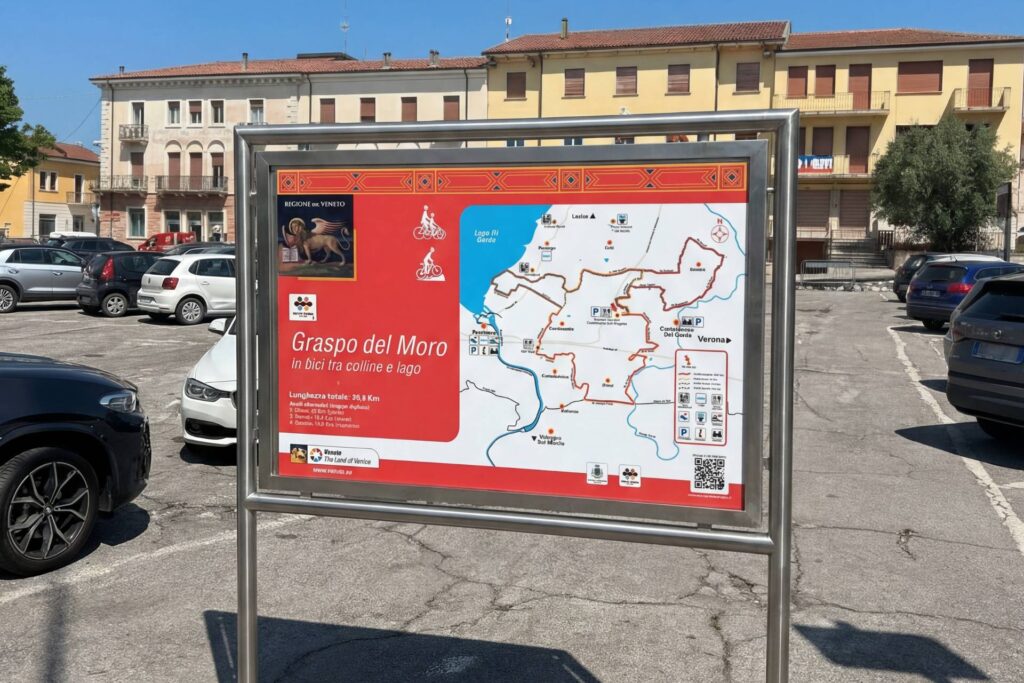
The Graspo del Moro loop covers approximately 37 km of the countryside surrounding Castelnuovo del Garda. It is a route of gravel tracks and quiet rural roads, of vineyards and open fields, of gentle climbs through the morainic hills and long descents with wide views.
Three shorter variants — Ronchi (19 km), Oliosi (22 km) and Sandrà (14 km) — branch off from the main loop, each exploring a different part of the territory at a different pace. The Ronchi loop reaches the lake at Lido Campanello. The Oliosi loop crosses open agricultural land to the north. The Sandrà loop stays close to the village, a short and gentle introduction to the landscape.
The route is signposted with over 170 signs on the ground. Four information panels with QR codes are placed at key points along the way, linking to digital maps and downloadable GPX files for all four variants. South Garda Bike Region updated and extended the signage as part of its work to make the territory more readable and more welcoming to cyclists.
What the route tells you
Riding the Graspo del Moro, you pass through the vineyards where the Moro dal Castel is still grown. You ride past farms that have been here for generations, along roads that follow the natural contours of the morainic landscape, through a countryside that has not been built over or altered beyond recognition.
It is a route that tells you something true about this territory — not just its shape, but its character. The name was not chosen for marketing. It was chosen because it was already there, already part of the land, already meaningful to the people who live and work here.
That is what makes the Graspo del Moro worth riding. Not just the landscape, though the landscape is beautiful. But the sense that you are moving through something with a history — and that history goes all the way down to the roots.
Ride the four routes



 English
  Italian
  German